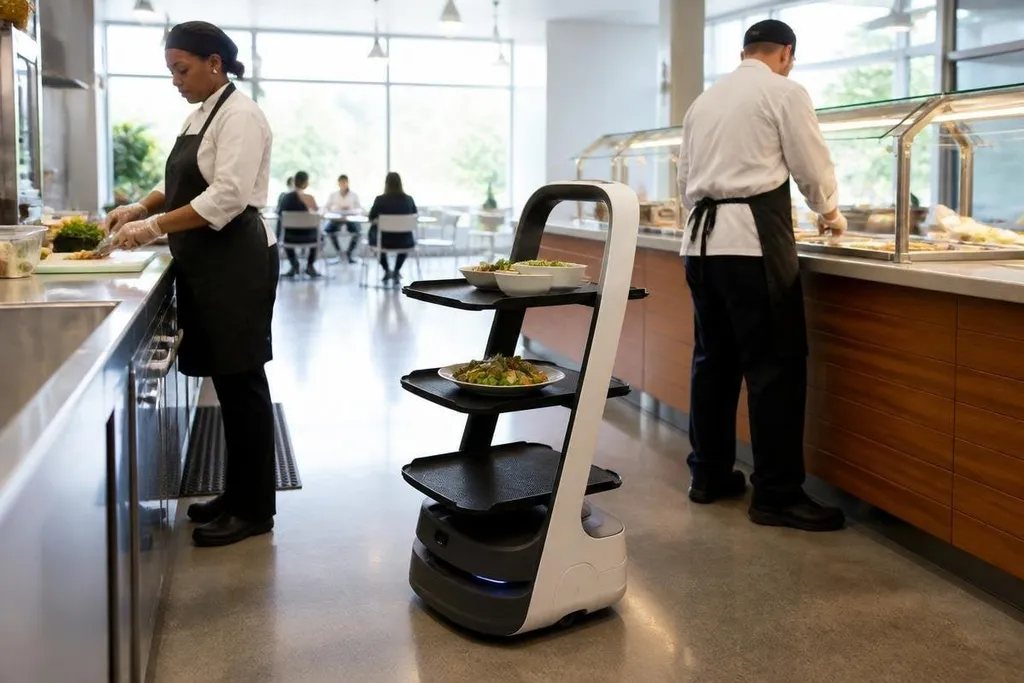
A catering job can involve moving food, repeating the same prep task, and working under tight serving times. Robots may take on parts of that work, but their value will depend on the room, the menu, and the people who need to use them.
Quick read:
- Repetitive prep and transport are the clearest starting points.
- Kitchens still need people for taste, judgment, cleaning, and service.
- The best first step is a small task trial with clear safety checks.
Where robots could help first
Catering has many short tasks that repeat across a shift. A robot could move trays between a kitchen and a serving area, carry supplies, or bring finished dishes to a pickup point. These jobs may reduce walking, lifting, and interruptions for staff.
Food preparation offers another possible use. A robotic arm could portion ingredients, place items into containers, or repeat a set cutting motion. The task must have a stable layout and clear limits, since food changes shape and workers may need to step in often.
Cleaning may also suit machines that follow fixed routes. A floor robot could work during quiet periods, while a separate system might collect trays or move empty containers. Those tasks still need checks around wet floors, cables, people, and objects left in the robot’s path.
The useful test is narrow: can the robot repeat one task safely for long enough to reduce work without slowing the team?
What changes for catering staff
Robots would change the shape of a shift rather than remove every human task. Staff may spend less time carrying loads and more time checking food, setting tables, handling guests, and fixing exceptions.
That shift creates new work. Someone must load the robot, check its route, clean the parts that touch food, and stop it when the room changes. A worker may also need to reset the system after a tray moves out of place or a person blocks the route.
Training matters because a machine that looks easy to operate can still cause delays when something goes wrong.
Workers need clear steps for starting, stopping, cleaning, and reporting faults. Those steps should fit the pace of a real service, not require a long technical process during a busy meal.
A busy meal service puts every robot claim against time, heat, spills, and human handoffs. Robot24.com's catering robotics coverage can help operators compare a robot's stated task with its cleaning needs, service time, and staff support. Those details matter before a kitchen treats a short demo as proof that the system can handle a full meal service.
The limits are clear
Food service is a difficult setting for robots because layouts change and people move without fixed paths. A dining room may change with each event, while a kitchen can become crowded when orders arrive together.
Food safety adds another layer. Any machine near ingredients needs a cleaning plan, suitable materials, and a way to stop work when contamination may occur. A robot that carries sealed trays faces a different problem from one that touches food directly.
Cost also matters. The purchase price is only one part of the decision. Catering operators need to account for installation, software, cleaning, repairs, staff training, and the space needed for the robot to work.
I'd start with transport or floor work before putting a robot near open food. The task is easier to separate from cooking, and a failed trial is less likely to interrupt the menu.
A practical trial plan
A small trial gives an operator a better answer than a broad promise. Use this checklist before choosing a machine:
- Pick one task: choose work with a clear start, finish, and repeatable route.
- Measure the baseline: record staff time, delays, lifting, and errors before the trial.
- Mark the workspace: show where people, carts, tables, and emergency stops will be.
- Set a stop rule: decide when a worker must pause the robot and take over.
- Check cleaning: list every surface that needs cleaning and how often it must happen.
- Review the result: compare the trial with the baseline before buying more equipment.
The trial should answer a business question, not prove that a robot can move. If staff spend as much time supervising the machine as they spent doing the task, the setup needs work or the task belongs to people.
What happens next
Catering robots will likely enter through contained jobs such as carrying, floor cleaning, and fixed preparation steps. Their reach will grow only when they can work safely around changing rooms, food rules, and human decisions. For now, the sensible path is one task, one measured trial, and a clear reason to keep the machine.